ECC
The agent harness performance optimization system. Skills, instincts, memory, security, and research-first development for Claude Code, Codex, Opencode, Cursor and beyond.
npx ecc-install --profile fullThe agent harness performance optimization system. Skills, instincts, memory, security, and research-first development for Claude Code, Codex, Opencode, Cursor and beyond.
npx ecc-install --profile fullFair-code workflow automation platform with native AI capabilities. Combine visual building with custom code, self-host or cloud, 400+ integrations.
npx n8nAn open-source AI agent that brings the power of Gemini directly into your terminal.
npx @google/gemini-cliEnglish | 简体中文 | 日本語 | Русский | Français
OpenConnector is an open-source connector gateway for AI agents and an alternative to Composio. Connect user app accounts once, then expose a shared catalog of 1,000+ providers and 9,400+ prebuilt Actions to agents and applications.
Use the Connector SDK from app code, oo CLI as the local-agent relay, MCP from agent hosts, HTTP/OpenAPI from custom clients, and the Web Console for administration and debugging.
OpenConnector fits products where agents need durable access to the tools users already use, without handing provider credentials to the agent process.
| Tool | Purpose |
|---|---|
| Connector SDK | Thin TypeScript HTTP client. Use OpenConnector for self-hosted runtimes, or Connector / ProjectConnector for OOMOL-hosted personal and SaaS end-user connections. |
| oo CLI | Local agent relay for connector Actions. oo connector can search, inspect, and run Actions against OOMOL-hosted or self-hosted OpenConnector runtimes. |
| MCP | Expose app Actions to MCP-capable agent hosts through http://localhost:3000/mcp. |
| HTTP / OpenAPI | Call /v1/actions/* directly or inspect the generated /openapi.json document. |
Endpoint details, response envelopes, auth headers, MCP tools, and Action guide examples are in docs/runtime-api.md.
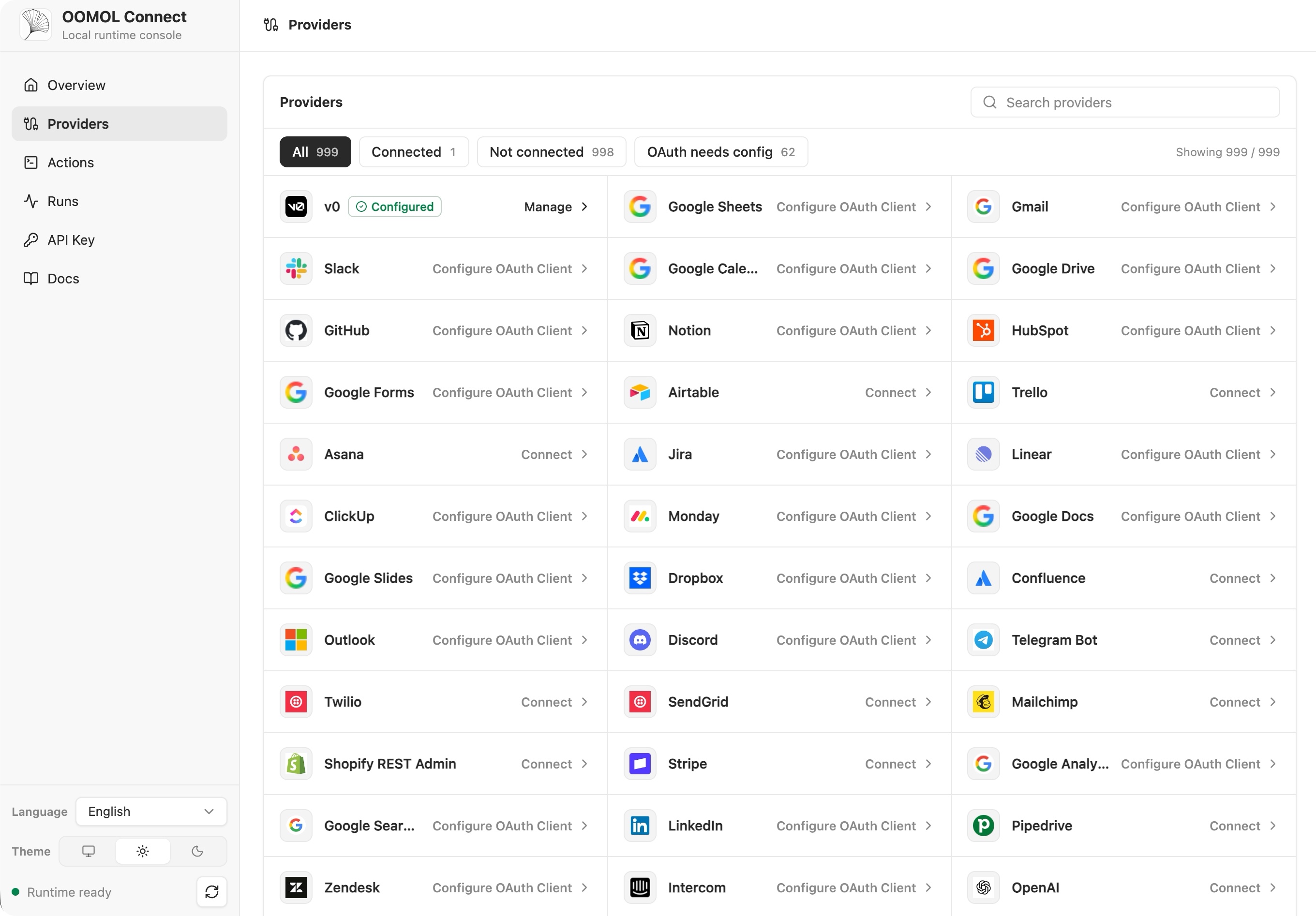
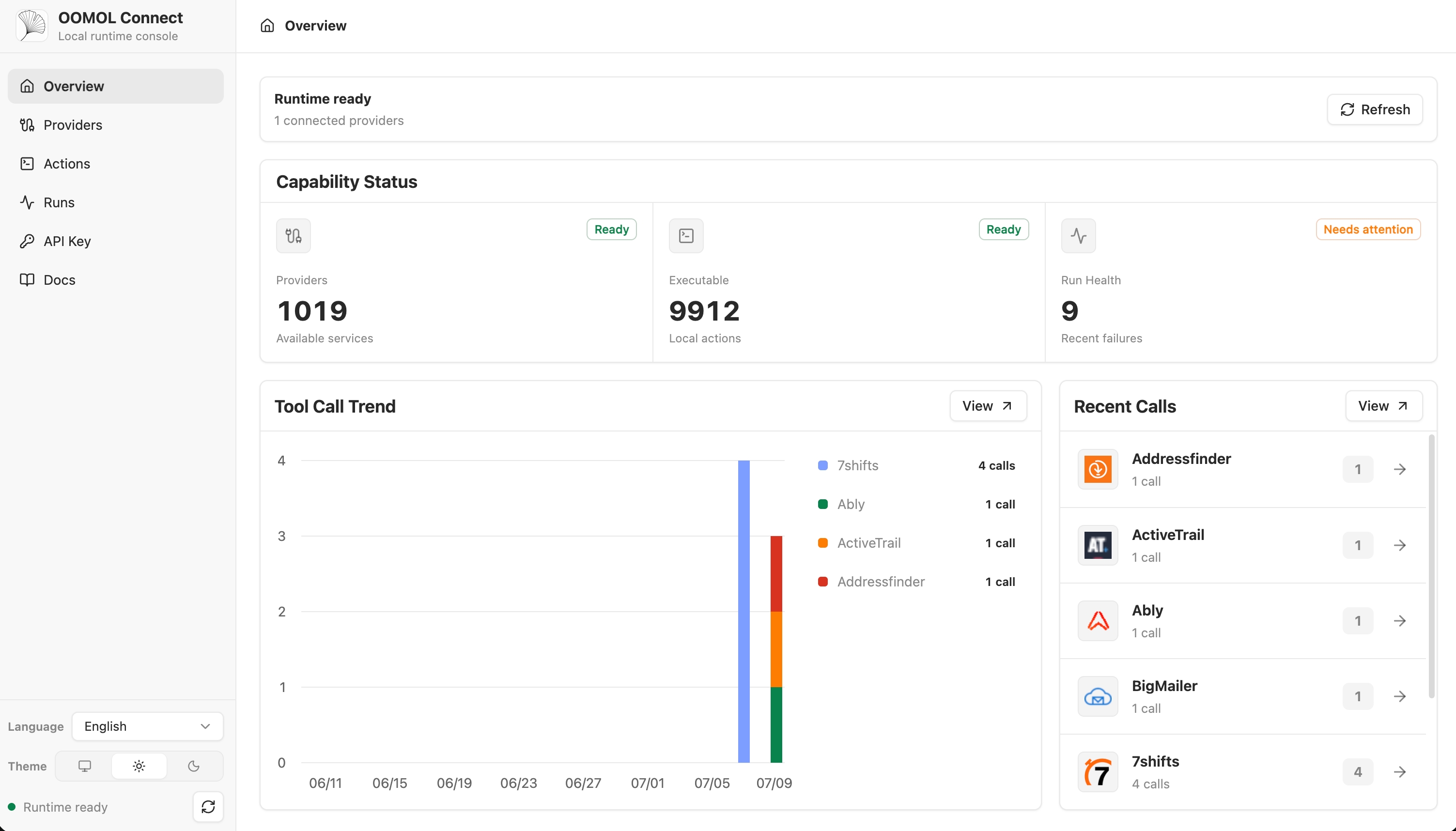
OpenConnector ships with a local Dashboard for browsing connectors, configuring credentials, creating runtime tokens, and inspecting runtime usage.
Use the connector catalog to see available services, search for providers, and open their Actions and credential setup from one place.

Use the Overview page after deployment to monitor runtime readiness, available providers, executable Actions, recent failures, tool call trends, and recent calls.

Provider names and trademarks belong to their respective owners and are used only for identification and interoperability.
flowchart LR
Agent["AI Agent / App"] -->|"SDK / CLI / MCP / HTTP"| Gateway["OpenConnector Gateway"]
Gateway --> Auth["Credential & OAuth Boundary"]
Gateway --> Catalog["Provider Catalog"]
Gateway --> Actions["Open-source Action Executors"]
Gateway --> Policy["Tokens, Scopes, Allow/Block Policy"]
Gateway --> Logs["Run Logs"]
Actions --> Providers["1,000+ Providers"]
Console["Web Console"] --> Gateway
Cloudflare["Cloudflare Workers, D1, R2"] -. deploy .-> Gateway
Apps and agents discover Actions, inspect schemas and scopes, select a connection alias, and execute through the gateway. Provider secrets stay behind the runtime boundary; agents receive the metadata, safe account labels, and execution results needed for the run.
| Path | Best for | Includes |
|---|---|---|
| Open-source self-host | Developers and teams that want full control | Local Docker or Node runtime, SQLite storage, MCP, HTTP, OpenAPI, and Web Console |
| Fly.io self-host | Teams that want a hosted Docker runtime | Node Docker runtime, SQLite storage on a Fly volume, TLS, health checks, MCP, HTTP, OpenAPI, and Web Console |
| Cloudflare-compatible deploy | Teams that want a lightweight hosted runtime | Workers runtime, D1 state, R2 transit files, and Static Assets for the console |
| OOMOL | Teams blocked by OAuth approval or launch deadlines | Hosted auth and runtime infrastructure with the same provider and Action contracts; compatible with the open-source interface for later private or self-hosted deployment |
The
Cloudflare Workers deployment walkthrough shows how
to launch OpenConnector on Cloudflare with Workers, D1, R2, and the Web Console. The video follows
the same flow as docs/cloudflare.md: create Cloudflare resources, copy
wrangler.example.jsonc to wrangler.local.jsonc, apply D1 migrations, set required secrets, and
run npm run deploy:cloudflare.
Start the runtime with Docker Compose:
docker compose up --build
Open the local console and generated API reference:
http://localhost:3000
http://localhost:3000/docs
Run a no-auth Action to verify the runtime:
curl -s -X POST http://localhost:3000/v1/actions/hackernews.get_top_stories \
-H 'content-type: application/json' \
-d '{"input":{}}'
See docs/quickstart.md for the full local setup, first provider connection, OAuth flow, and runtime settings.
GitHub is the simplest credentialed example because it can use a personal access token:
curl -s -X PUT http://localhost:3000/api/connections/github \
-H 'content-type: application/json' \
-d '{"authType":"api_key","values":{"apiKey":"github_pat_..."}}'
curl -s -X POST http://localhost:3000/v1/actions/github.get_current_user \
-H 'content-type: application/json' \
-d '{"input":{}}'
For OAuth2 apps, named connections, credential encryption, token refresh, and action policies, see docs/credentials.md and docs/configuration.md.
For npm-based local development, open http://localhost:5173; the Web Console dev server proxies
API requests to the runtime on http://localhost:3000. For Docker or a built Node runtime, the
console is served from http://localhost:3000.
The console supports provider browsing, API key and OAuth client configuration, runtime token creation, Action schema inspection, Action debugging, recent run review, and access to the generated OpenAPI and MCP metadata.
OpenConnector can run on Cloudflare with Workers for the runtime, D1 for state, R2 for transit files, and Static Assets for the Web Console.
See docs/cloudflare.md for resource creation, migrations, secrets, local Worker preview, and remote deployment.
OpenConnector can also run on Fly.io with the Node Docker runtime and persistent SQLite storage on a Fly volume.
See docs/fly-io.md for app creation, volume setup, secrets, deployment, custom domains, and scaling.
The paths above are for teams integrating connectors into their own products, runtimes, or infrastructure. If you want to try the SaaS connection experience first, or use it directly in day-to-day work, you do not need to deploy OpenConnector or integrate the SDK, CLI, MCP, or HTTP API first.
Wanta is the desktop product entry point using the same shared 1,000+ SaaS/provider coverage. Connect accounts once, then use natural language to search, organize, create, and sync across connected tools.
| If You Want to | Wanta Provides |
|---|---|
| Try 1,000+ SaaS connections directly | Use the same SaaS/provider coverage without deploying a runtime or integrating SDK/CLI first. |
| Use Agents in daily work | Work across email, chat, docs, data, projects, support, developer tools, and marketing tools in natural language. |
| Share connected capabilities with a team | Configure connections and access scopes once; teammates use them without setup while keys, tokens, and credentials stay hidden. |
Use Node.js 22 or newer:
npm install
npm run dev
The local API runtime listens on http://localhost:3000. The Web Console dev server listens on
http://localhost:5173 and proxies API requests to the runtime.
Before opening a pull request:
npm run fix-check
npm test
Provider code lives under src/providers/<service>. See
CONTRIBUTING.md for provider contribution rules.
Unless otherwise noted, the source code, scripts, generated project scaffolding, tests, and documentation authored for this repository are licensed under the Apache License, Version 2.0. See LICENSE.txt.
The Apache-2.0 license for this repository does not grant rights to third-party products, providers, apps, APIs, trademarks, service marks, trade names, logos, icons, brand assets, documentation, screenshots, or other copyrighted materials owned by their respective holders.
Provider and app names, metadata, links, scopes, permissions, and optional logos/icons are included only to identify services and enable interoperability. All third-party brand and product rights remain with their respective owners. Inclusion in this catalog does not imply endorsement, sponsorship, partnership, certification, or verification by those owners.
If you contribute provider metadata or assets, only submit material you have the right to submit. Prefer linking to official public assets instead of copying brand files into this repository.
Please keep issues and pull requests focused, respectful, and actionable. Participation in this project is governed by CODE_OF_CONDUCT.md.